Catholic Update: Types of Beliefs in Catholicism

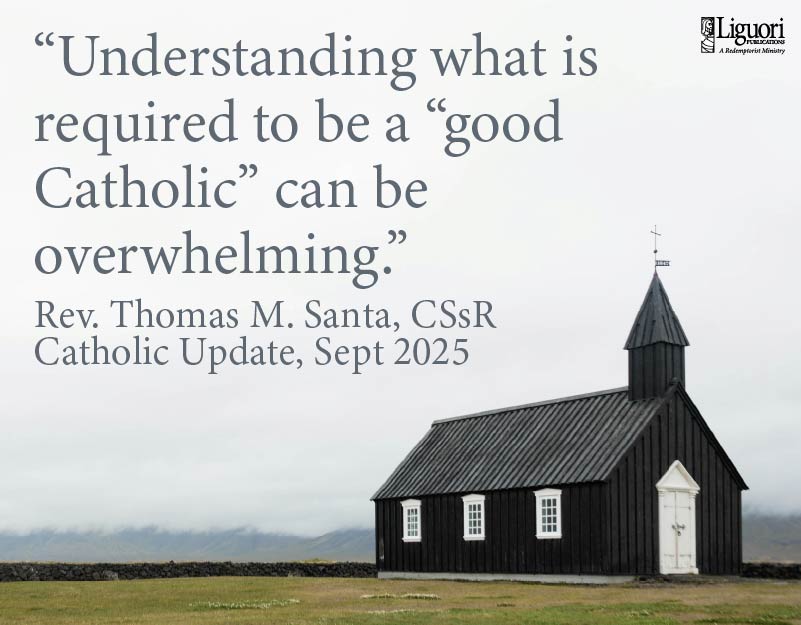
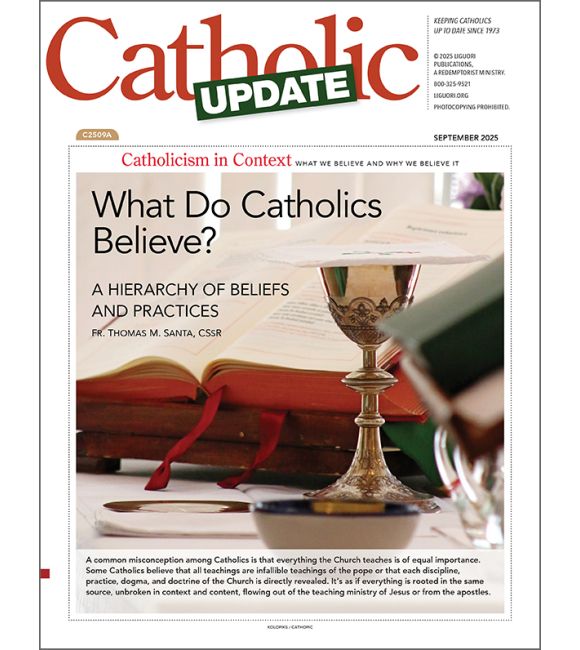
September’s issue of Catholic Update features articles from Rev. Thomas M. Santa, CSsR on the various types of beliefs in Catholicism and how they come about. Check out this excerpt!
...
Understanding what is required to be a “good Catholic” can be overwhelming. Some people, disrespectfully categorized as “cafeteria Catholics,” supposedly choose what they believe and practice, disregarding the rest. Others embrace a form of so-called “traditional” Catholicism, believing that to find clarity, they must reclaim a purer discipline. It is not surprising that there is often confusion, misunderstanding, and even frustration that lead to a disconnect from Tradition and the Church. This could be the unintended result of poor catechetical training or insufficient education, but the role of dueling social-media “talking heads” also cannot be discounted. There is a kind of trench warfare going on in social media, and people who become confused and disheartened are seen as the unfortunate casualties of the battle for theological purity.
In Catholic doctrine there exists an order or ‘hierarchy’ of truths, since they vary in their relation to the foundation of the Christian faith” (Catechism of the Catholic Church, 90). If we understand the teachings of the Church within the context of this hierarchy, it may be easier to focus on what is important and necessary—what is essential truth—without feeling like a bad Catholic and without passing such judgment on others. This hierarchy includes revealed truth, dogma, and pastoral application.
Revealed Truth
There are truths that were revealed through the life and ministry of Jesus: belief in the Holy Trinity; the Incarnation, passion, and resurrection of Christ; the Second Coming and Final Judgment of Christ; the remission of sins; the Church; and eternal life. These subjects are understood as doctrines and are also classified as creedal formulas.
Dogma
In addition to the revealed truths listed in the previous paragraph, there are dogmas of the Church. These dogmas are found within the constant teaching tradition of the Church and in sacred Scripture, and each dogma has been clarified and explained primarily through the ecumenical councils. Another way to understand them is through the magisterium, the teaching authority of the Church.
The Council of Trent (1545–1563), in response to the Protestant reformers, made a number of dogmatic definitions about the sacraments and other beliefs and practices of the Church. In addition to Scripture, Tradition, and revealed truth, select teachings have been declared dogmatic by the pope, speaking ex cathedra (that is, from the Chair of St. Peter).
Pastoral Application
Flowing from the understanding of the dogmatic and doctrinal traditions of the Church, and clarified by the magisterium over the centuries, certain precepts, practices, laws, and disciplines of the Church have emerged as central to our understanding of what it means to be Catholic. These are often understood collectively as the “pastoral application” of the Christian faith. In other words, these tenets are applied by official pastors and teachers as well as by individuals who are engaged in day to-day practice of the Catholic faith.
Pastoral application, as one might assume, is dependent on the individual interpretation and experience of the person who is applying the practice. We assume and hope that these pastoral practices are evenly
applied, but that is not always the case. The reality is that different interpretations are possible, which should be expected whenever human beings engage in interpretation.
It is also true that practices, interpretations, and disciplines change often and are dependent on historical context. For example, the holy days of obligation are not the same in all countries. They are often dependent on the local circumstances and lived experience of the people of God.
...
Read more in the September 2025 edition of Catholic Update.
Catholic Update is a monthly subscription great for both parishes and individuals! Find more information about Catholic Update and other great subscription offerings from Liguori Publications at subscriptions.liguori.org/.
Related Posts
Related Products