1960s: Answering Anxious Questions Inside and Outside the Church

1960s: Answering Anxious Questions Inside and Outside the Church</>
By Fr. Byron Miller, CSsR, President and Publisher of Liguori Publications
The 1960s is considered the most turbulent decade of the 1900s. Polarization over the Vietnam War, the civil rights movement, social unrest over a variety of concerns, assassinations, and a widening generation gap contributed to this dubious distinction. However, the period was also characterized by idealism, hope, and new frontiers for humanity in landing men on the moon and for the Catholic Church in convening the Second Vatican Council (1962–65).
Not since the Council of Trent (1545–63) had an ecumenical council made so profound an impact on Catholic life and belief. Consequently, the monumental vision and dramatic reforms of Vatican II and its aftermath—joined with the rapid changes in society—helped spawn confusion and anxiety among many members of the faithful.
Liguorian steers a steady course
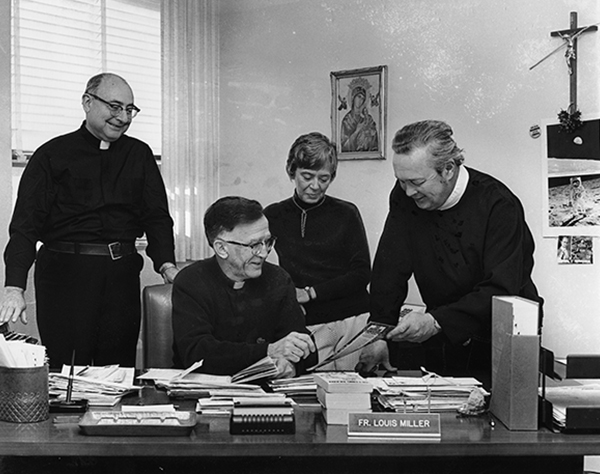
Liguori Publications responded to this uncertainty in a number of ways that readers found effective. For example, Fr. Louis Miller, CSsR, was appointed editor of Liguorian in 1961, a position he held until 1976. During this lengthy tenure, he capably steered a middle course for the magazine—incidentally, as did our patron, St. Alphonsus Liguori in his writings during the 1700s. And like Alphonsus, Fr. Louie was simultaneously accused of being too liberal and too conservative. His successor, Fr. Norm Muckerman, CSsR, wrote that Fr. Miller’s middle-of-the-road approach was affirmed at the 1969 meeting of American Bishops and Editors in Dayton when the bishops singled out Liguorian among Catholic magazines as worthy of praise. “It presents,” they stated, “a balanced picture of the teachings of the Church and the needs of modern Catholics in today’s world.”
As a sign of the times, Fr. Louie broadened the perspective of Liguorian to include lay writers, and he hired the first woman associate editor, Francine M. O’Connor.
Liguori Publications Responds
Scrupulous Anonymous a monthly newsletter from Liguori Publications for people suffering with scrupulosity, debuted in 1964. People with the disorder suffer symptoms like excessive feelings of doubt and anxiety in decision-making. The newsletter is still published today. To receive it, visit scrupulousanonymous.org.
By the end of the decade, Liguori Publications noticed an increase in the volume of letters and phone calls from people who were asking fundamental questions about their Catholic faith. According to Fr. Paul Coury, CSsR, “These were Catholics who grew up in the experimental years of religious education in the mid- to late 1960s. They were now adults, settled in communities, with their children attending very structured religious education classes. These parents found themselves unable to answer many of the religious questions that their children brought home from those classes. The parents would call their parish priest, the director of religious education, or even a Catholic publishing house to find the answers.”
A Best-Seller is Born
In response to this climate of questioning wrought in part by the Vatican II changes, Liguori published Handbook for Today’s Catholic, containing the basics of Catholicism in the spirit of Vatican II. Handbook has become the company’s all-time best seller, with close to six million copies distributed.
It also triggered a weekly question-and-answer column in the company’s Sunday bulletin for parishes called “Dear Padre.” That column quickly became a hit, surpassing the one million mark in readers, and it remains popular in our bulletins to this day. A
Next: Dealing with disillusionment in the 1970s
Related Posts
Pop the Cork! Drop the Confetti! Stop the Presses!

Liguori Publications Celebrates 75: The Boom Years of the 1950s

1970s: Liguorian Takes a Stand Against a Divisive War While Promoting Justice
1980s: Liguori Publications Embraces the Digital Explosion

1990s: Liguori Publications Goes Global